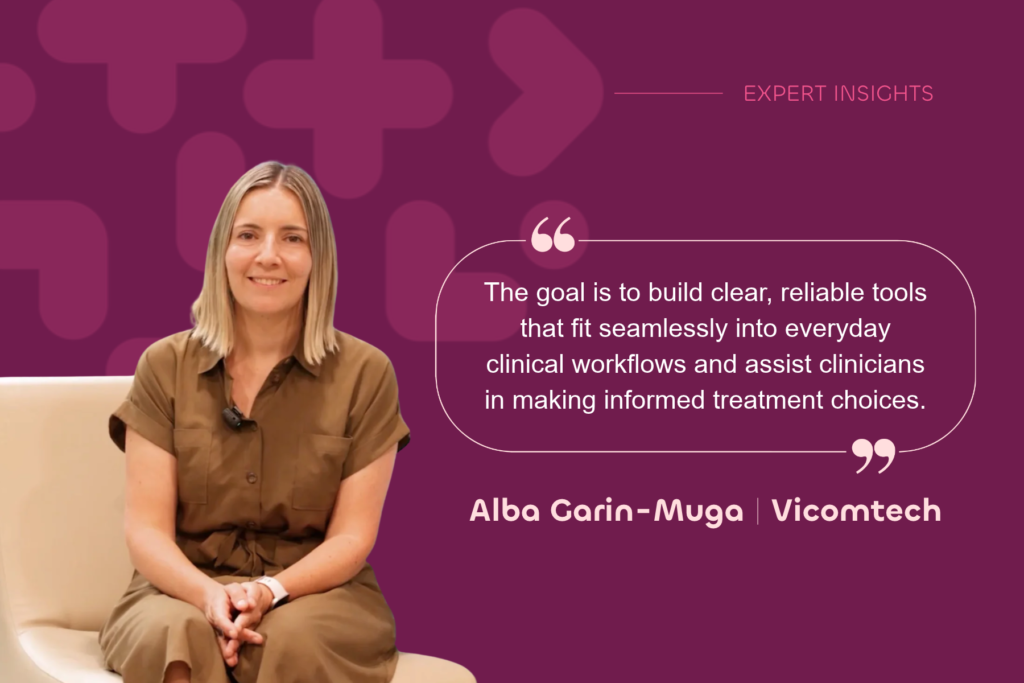
This article has been developed in collaboration with Vicomtech, a partner of the COMPASS project, and written by Alba Garin-Muga, Senior Researcher and Head of the Precision Predictive Medicine line at Vicomtech.
COMPASS provides digital health tools such as AI-based Clinical Decision Support Systems (CDSS) bridging oncology and cardiology for prevention, early detection and monitoring of cancer treatment cardiotoxicity
Cancer therapies have improved significantly in recent years, helping many patients survive and live longer, healthier lives. However, these treatments can sometimes cause unintended side effects on the cardiovascular system. Known as cardiotoxicity, these heart complications can force doctors to pause essential cancer therapies or cause long-term health issues for survivors. To address this, the European COMPASS project aims to identify patterns associated with risk of cardiovascular toxicity using Artificial Intelligence and transform complex clinical information into knowledge that can support personalised care.
To develop AI-based Clinical Decision Support Systems (CDSS), three complementary AI capabilities are particularly relevant: deep phenotyping and multimodal AI, predictive modelling, and knowledge exploitation through large language models (LLMs).
Deep phenotyping: building a richer representation of the patient
Deep phenotyping enables the creation of a multimodal digital profile, integrating multimodal and longitudinal deep data to characterize and understand phenotypes by computational means, typically multimodal deep learning, driving the advance of precision medicine. This allows to understand complex patterns and relationships between data sources, identify causal relationships, characterize phenotypes and their clusters and/or derive new multimodal biomarkers or mechanistic interpretations, among other applications, converting complex data into meaningful compact representations and insights.
Modern healthcare produces diverse data types, from cardiac scans and lab results to genetic profiles and wearable device signals. Rather than analysing these data sources in isolation, COMPASS uses multimodal AI to integrate them into a unified view and draw relevant patterns, relationships, biomarkers and insights. These will be isolated and translated into actionable clinical decision-making tools, providing care teams a complete picture of how a patient’s heart responds to cancer treatment over time, which is particularly critical in cardio-oncology, where cardiovascular risk evolves continuously.
Predictive models: identifying patterns of cardiotoxicity risk
When all the information from the patient is integrated in the digital patient profile, predictive models can help clinicians spot potential issues early. Instead of reacting after heart damage occurs, machine learning and deep learning algorithms analyze patient trends to assess cardiotoxicity risks. By catching subtle indicators of heart strain early, oncologists and cardiologists can adjust treatment dosages, start protective heart medications, or change treatment plans to keep cancer care safe and effective. Within COMPASS, this approach contributes to the development of AI-driven models, validated and translated into actionable tools aimed at supporting the assessment of cardiovascular risk in people with cancer and cancer survivors.
From data to knowledge: LLMs and cognitive systems
To make these insights practical, COMPASS also leverages Large Language Models (LLMs). Much healthcare data remains embedded in unstructured documents such as clinical notes, diagnostic reports, and research papers. LLMs can extract, structure, summarize and connect information from these free-text records, compare findings with current medical guidelines, and present concise summaries so clinicians can quickly access critical details, converting knowledge and historical records into actionable contextual information at the point of care. LLM-based approaches and embedding AI agents can also provided meaningful explainations, improving the explainability and integrating AI, evidence and multimodal data and knowledge into clinically-sound interpretations.
Vicomtech is leading the development of the COMPASS Clinical Decision Support System (CDSS)
As leaders of Work Package 6 (WP6) in the COMPASS consortium, Vicomtech leads the development of the Clinical Decision Support Systems (CDSS) that integrate these predictive algorithms with existing clinical knowledge and evidence and intuitive visualizations for improved decision-making. The goal is to build clear, reliable tools that fit seamlessly into everyday clinical workflows and assist clinicians in making informed treatment choices.
«Artificial intelligence in healthcare works best when it supports medical professionals as a practical, reliable assistant. Within COMPASS, our focus at Vicomtech is to combine deep phenotyping, predictive analytics, knowledge and evidence into intuitive, visually rich and explainable decision-support tools. We aim to provide clinicians with straightforward insights so they can focus on delivering safe, personalized care to every patient.»
— Dr. Iván Macía, Head of Digital Health and Biomedical Applications at Vicomtech
COMPASS aims to improve cardiotoxicity management and ensure cancer treatments protect both the patient’s health and their heart, improving the quality of life of cancer survivors.