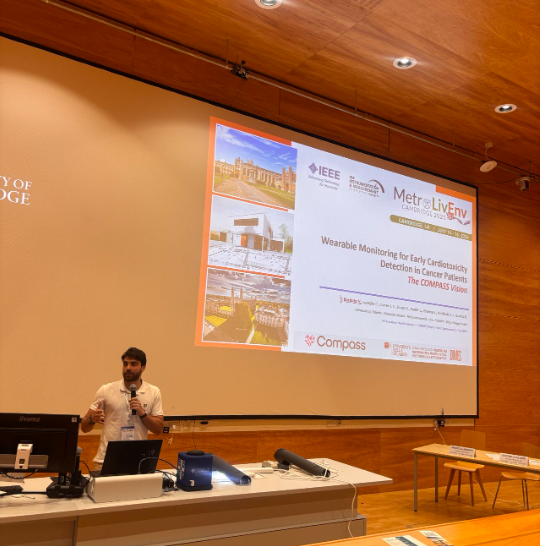
The COMPASS project was recently represented at the IEEE International Workshop on Metrology for Living Environment (IEEE MetroLivEnv 2026), held in Cambridge, United Kingdom, where researchers presented ongoing work exploring the potential of wearable technologies to support the early detection of cardiotoxicity in cancer patients.
The contribution, entitled «Wearable Monitoring for Early Cardiotoxicity Detection in Cancer Patients: The COMPASS Vision,» highlights how continuous, non-invasive monitoring could help extend cardiovascular assessment beyond the hospital environment, supporting earlier identification of cardiovascular complications associated with cancer treatments.
«This is particularly relevant in cardio-oncology, where cardiovascular toxicity induced by cancer therapies can be subtle, transient, or progressively evolving, and may remain unnoticed between scheduled clinical visits,» explained Vincenzo Barbuto from the University of Calabria (UNICAL), who presented the COMPASS research at the workshop.
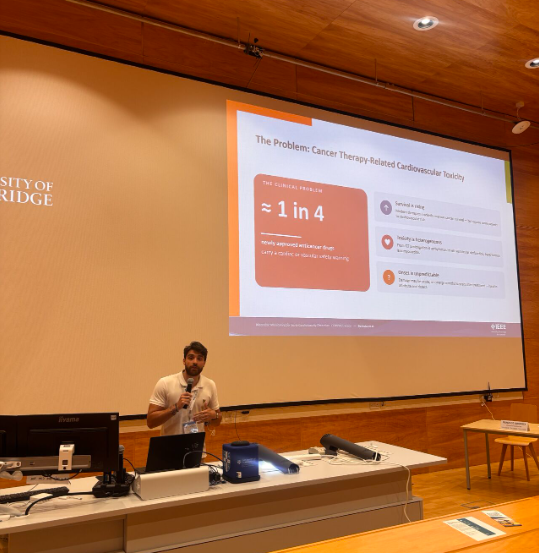
Advancing continuous cardiovascular monitoring beyond the clinic
Cardiotoxicity remains one of the major challenges in cardio-oncology. While routine clinical assessments play a fundamental role in patient follow-up, cardiovascular changes may develop between scheduled visits. This is where wearable technologies could make a significant difference, providing continuous, non-invasive monitoring that complements conventional clinical evaluation and supports earlier identification of potential cardiovascular complications.
The work presented at IEEE MetroLivEnv 2026 reviewed several of the sensing technologies currently being investigated within the COMPASS framework, including electrocardiography (ECG), photoplethysmography (PPG), blood pressure monitoring, and inertial measurement unit (IMU)-based sensing. The presentation also addressed the opportunities these technologies offer, together with the practical and technical challenges that still need to be overcome before they can support reliable long-term monitoring in routine clinical practice.
Supporting the COMPASS vision for personalised cardio-oncology care
This research reflects one of the key ambitions of COMPASS: integrating advanced digital health technologies into a patient-centred cardio-oncology pathway capable of predicting cardiotoxicity risk, supporting earlier detection of cardiovascular complications, and enabling more personalised monitoring of cancer patients and survivors.
Presenting this work at an international scientific workshop also provided an opportunity to exchange knowledge with researchers working at the intersection of healthcare, engineering, digital technologies and measurement science, reinforcing the multidisciplinary collaboration that underpins the COMPASS project.
The presentation was delivered by researchers from the University of Calabria (UNICAL), with contributions from several COMPASS partners and collaborators, demonstrating the project’s collaborative approach to addressing one of the most pressing challenges in cancer survivorship.